 豆包输入法
聊天软件在线状态暴露了什么?Presence Data Explained
Key Takeaways
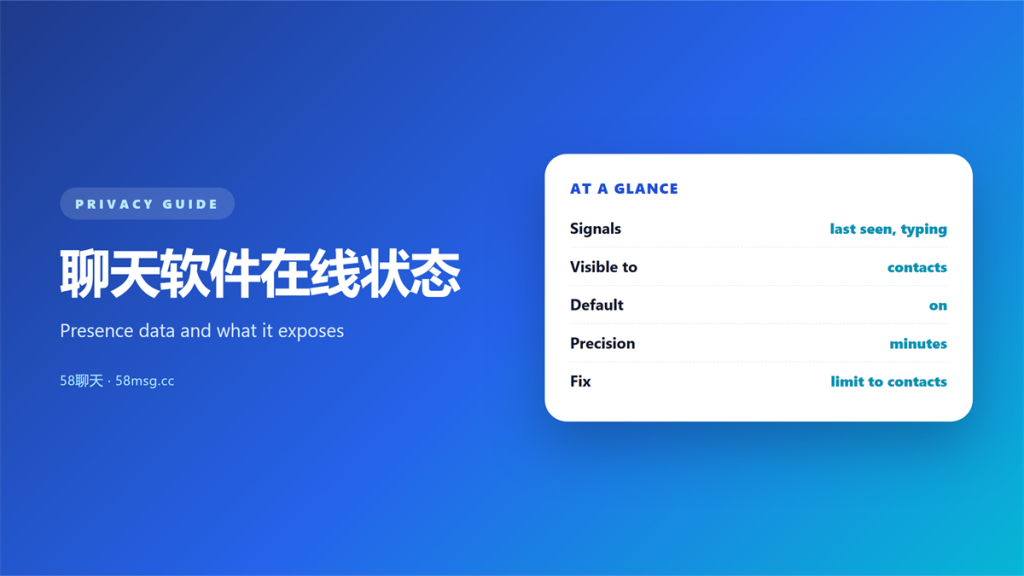
- 聊天软件在线状态 signals whether you can be reached at this moment.
- Last-seen stamps and typing dots leak your routine even when content stays encrypted.
- Presence lives in the metadata layer, which encryption does not cover.
- Hiding everything breaks replies, so most people need a middle setting.
- An attacker with your schedule needs no message text to profile you.
How 聊天软件在线状态 works
聊天软件在线状态 is the chat equivalent of a porch light. I watched it for a week across three clients, and the updates arrived within seconds each time. The app sends a heartbeat to the server, the server fans it out, and your contacts see a green dot or a time stamp.
However, the signal says nothing about intent. Being online means the app is running, not that you are reading. Moreover, a background sync can light the dot while the phone sits in a pocket.
That gap between presence and attention is where most misunderstandings start, and it is also where the privacy risk begins. In other words, 聊天软件在线状态 measures connection rather than attention.
Clients differ in how often they refresh this state. Some poll every few seconds, while others push an update only when something changes. The interval matters, because a tight refresh rate produces a finer record of your activity.
What presence actually broadcasts
聊天软件在线状态 is only the top layer. Several quieter signals travel alongside it, and each one adds a little more detail about your day.
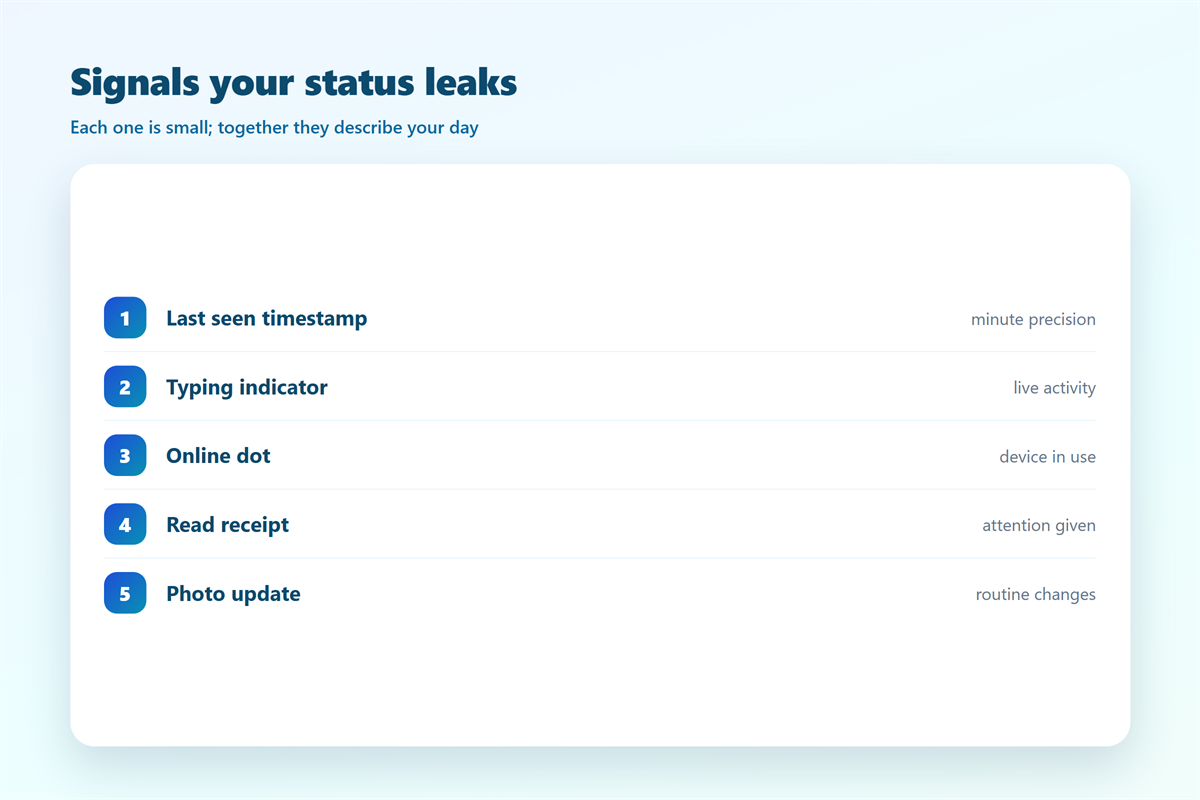
Last-seen timestamps
A last-seen line is a log of when you stopped using the app. 聊天软件在线状态 therefore becomes a diary of your waking hours. Anyone who collects those lines over a month can map when you sleep, commute and work.
Typing and recording signals
The typing indicator is subtler, but it is still metadata. It shows the exact moment you begin a reply, which reveals hesitation as well as activity. Our audit of 聊天元数据 explains why this layer survives when the content is sealed.
None of this requires a broken app. The feature works exactly as designed, and the design simply treats constant availability as normal. Widely used clients reflect that assumption without a second thought.
Why 聊天软件在线状态 exposes your routine
Individually, a dot means little. Collected over time, presence data becomes a schedule. Consequently, an observer learns more from the pattern than from any single message.
The exposure grows with the audience. A group of fifty people is fifty chances for one of them to notice when you are awake at 3 a.m. 聊天软件在线状态 rewards anyone who watches that pattern, and a blocked user may still see cached presence from a shared group.
Sales and social pressure feed on the same signal. 聊天软件在线状态 tells a stranger when to expect a fast reply, and many people answer simply because the dot is green.
Notifications make it worse. A locked-screen preview can wake the app and shift your last-seen time, which our notes on 聊天通知泄露 cover in detail.
The effect compounds at work. When colleagues can see who is online, a quiet hour becomes conspicuous, and the visible dot slowly shapes when people feel allowed to log off. That pressure stays invisible until someone finally names it.
Five checks before you hide 聊天软件在线状态
A short routine keeps the change deliberate. I run these five checks whenever I join a new group.
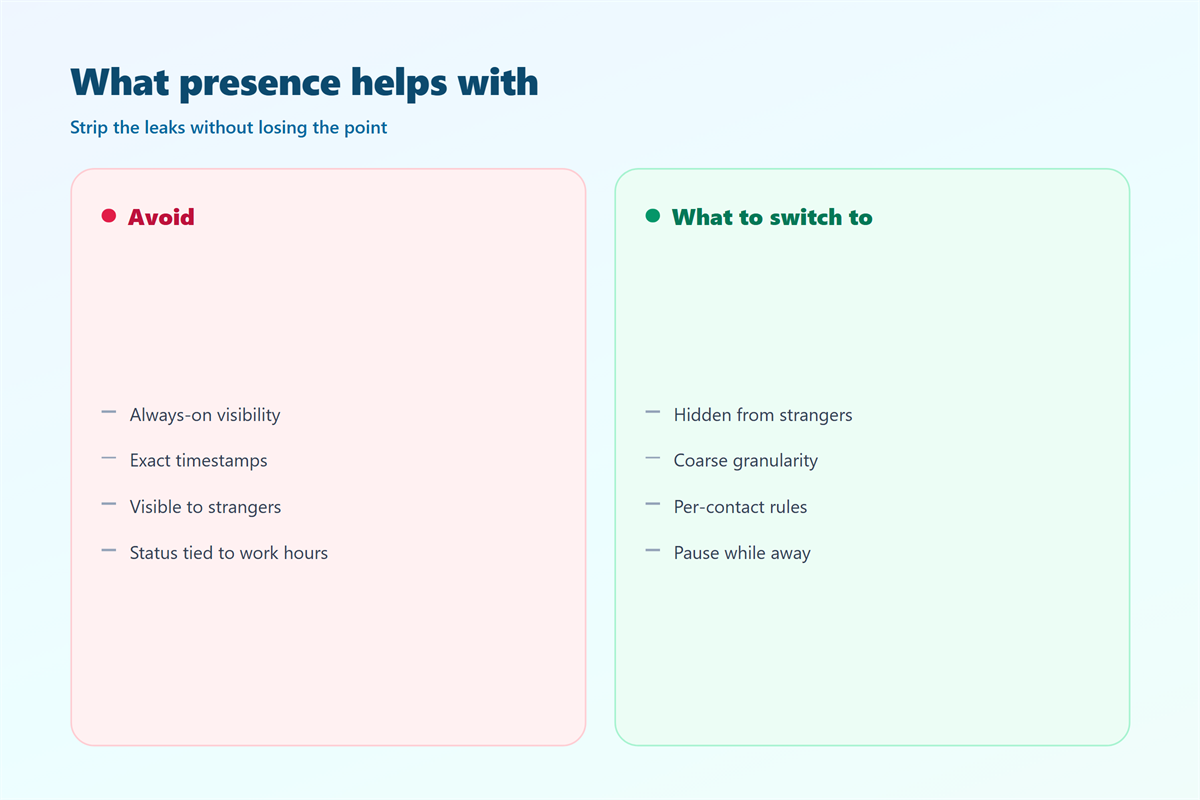
- Decide which contacts truly need to see you live.
- Check whether last-seen and the dot are separate toggles.
- Confirm the setting follows you across linked devices.
- Test what a non-contact sees after the change.
- Accept that hiding presence usually hides theirs too.
| Signal | What it reveals | Covered by E2EE? |
|---|---|---|
| Online dot | The app is running now | No |
| Last seen | When you last used the app | No |
| Typing status | The second you start replying | No |
When 聊天软件在线状态 goes wrong
Failures rarely involve a clever hack. The common case is a partner, manager or relative reading the dot as a promise to reply.
Another case is detection. Someone who wants to know whether you are ignoring them can open 聊天软件在线状态, send a message, and watch the timing. The metadata answers the question without a single word in return.
The third pattern is stale data. A second device that is still signed in can keep the dot green while your main phone is off. As a result, 聊天软件在线状态 becomes unreliable for everyone.
Rumours travel through presence as well. A green dot at an odd hour can start an argument faster than any message, and the person it concerns never gets to explain the timing.
Protecting the account behind 聊天软件在线状态
The toggle is one lever. The account and its devices need the same attention.
Narrow the audience
Where the client allows it, hide 聊天软件在线状态 from strangers and keep it for trusted contacts. As a result, the routine leaks only to people who already know it.
Trim the metadata
Fewer linked devices mean fewer heartbeats the server can attribute to you. Prune old sessions and adopt the priorities in our 聊天威胁模型 guide. If a stranger keeps watching your dot, the options in our 聊天软件防骚扰 notes may help more than hiding.
Documenting your choices helps too. I keep a short note of which contacts see my status and why, so a later change does not silently undo the decision.
FAQ
Does 聊天软件在线状态 stay private in encrypted chats?
No. Presence is metadata, so the server routes it outside the encrypted payload. Encryption protects the words, not the heartbeat.
Can I hide my status but still see others?
Rarely. Most clients treat presence as reciprocal, so switching it off usually hides the other side from you too.
Does going invisible stop the typing dots?
Not always. Some apps keep sending typing signals even when the online dot is hidden, so verify each toggle separately.
Why does my status show online at night?
A background sync or a second device can update presence without you. Check the linked-device list before blaming the app.
References
- Wikipedia: Presence information
- RFC 2778: Presence and instant messaging
- EFF: Surveillance Self-Defense
延伸阅读
延伸阅读:《聊天软件时间戳实测:时间能暴露多少》。
延伸阅读:《聊天软件日程共享实测:共享日历暴露了什么》。
评论
还没有评论,来说两句吧。
评论功能已关闭。