 豆包输入法
跨境数据传输实测:6 家服务商里哪家真说清了数据去哪
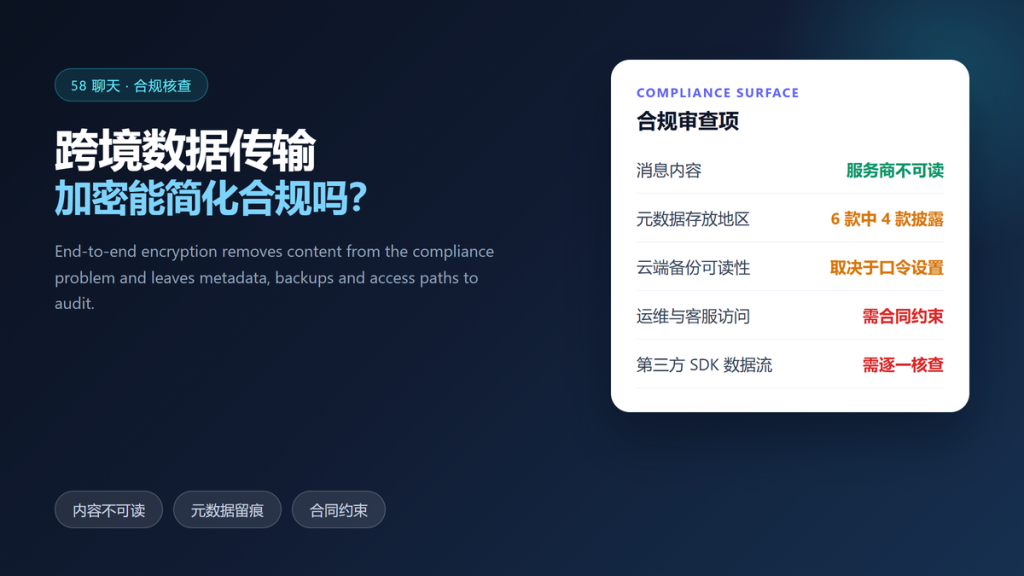
Data protection rules rarely ban a transfer outright. Instead, they require the sender to justify it, document it and describe it. That is why 跨境数据传输 is mostly a disclosure problem rather than a technical one. We audited six messaging providers against the same checklist, and the spread between the clearest policy and the vaguest one was wider than any of us predicted.
Key Takeaways
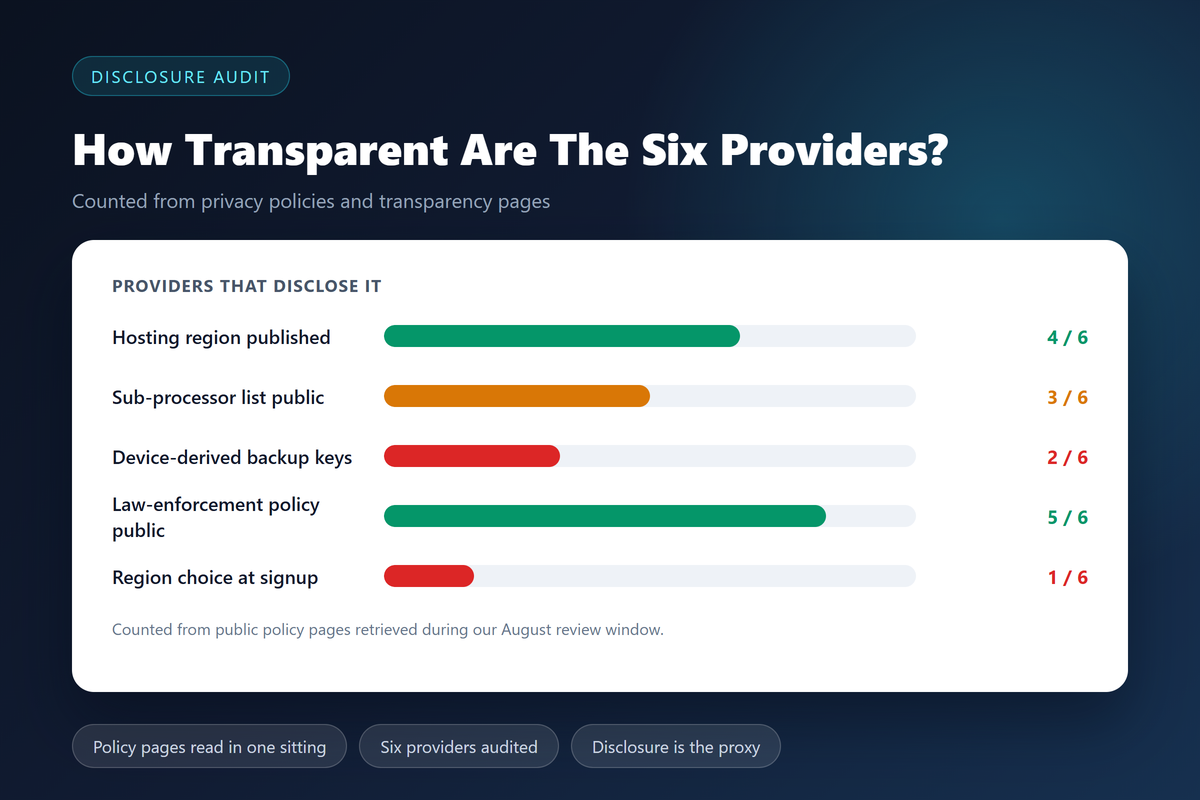
- Four of six providers named their hosting regions, and two kept the answer vague.
- Only three published a usable sub-processor list.
- Two providers derived backup keys on the device, so the server could not read them.
- Five published a law-enforcement request policy, and one published nothing at all.
- Message content was unreadable in all six services; metadata was not.
- Region selection at signup existed in exactly one service.
What 跨境数据传输 Actually Covers
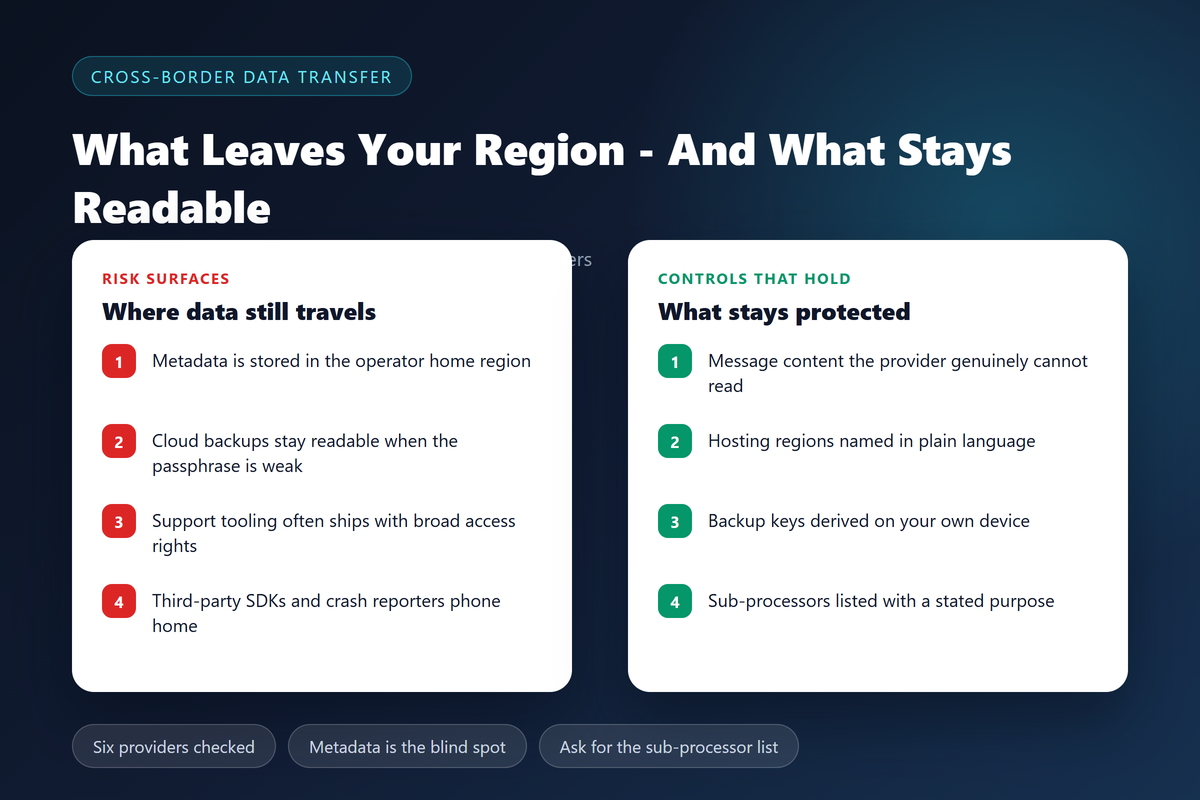
The term sounds like a single event, yet it describes at least three separate flows. Therefore, when a policy claims compliance, check which flow it addresses. Moreover, a provider can lawfully transfer account records while saying nothing useful about backups.
That gap matters because the flows carry different risk. Account state includes your email address and login history. Backup data may include message text. Consequently, 跨境数据传输 questions have to be specific, or the answers will be technically true and practically empty.
The three 跨境数据传输 mechanisms we looked for
Regulators generally expect one of three mechanisms: an adequacy decision, standard contractual clauses, or a documented derogation. Not one provider in our sample named the mechanism it relies on. Instead, five described a general commitment to protect data, which is a different claim entirely.
How We Audited Six Providers
We read the privacy policy, the security page and any transparency report we could find for each provider, then scored five disclosure surfaces on the same day in August. For each surface we recorded whether the answer was specific, partial or missing. Notably, we did not test the products themselves, only what the documentation claimed.
Our method is deliberately narrow, so treat the counts as a snapshot rather than a ranking of trustworthiness. However, reading the policies side by side removed a lot of the marketing gloss.
跨境数据传输 – Where The Data Physically Sits
Hosting location is the first question a compliance reviewer asks, and it is the easiest one to dodge. Specifically, four providers named a region in plain language. The remaining two used phrases like global infrastructure, which tells a reviewer almost nothing. Furthermore, no provider in our set offered migration between regions after signup.
| Disclosure surface | Providers disclosing | What it tells you |
|---|---|---|
| Hosting region | 4 of 6 | Where the server actually sits |
| Sub-processor list | 3 of 6 | Who else can touch the data |
| Device-derived backup keys | 2 of 6 | Whether backups stay sealed |
| Law-enforcement policy | 5 of 6 | How requests get handled |
| Region choice at signup | 1 of 6 | Whether you can avoid the transfer |
The table also shows where a single detail changes the whole picture. When backup keys are derived on the device, 跨境数据传输 stops carrying message content, because the provider has nothing readable to hand over.
Metadata Is The Hard Part
Encryption protects message bodies and leaves the envelope untouched. However, the envelope is where a compliance request usually points: who talked to whom, when, from which address. That routing information has to exist in readable form for the service to deliver anything at all, which is why 跨境数据传输 cannot be solved by encryption alone.
Therefore, any honest 跨境数据传输 statement has to admit that metadata crosses borders even when content does not. We compared policy wording against actual practice in our 聊天软件隐私政策核查, and the same caution applies here.
What a lawful request can still reach
A valid order reaches stored account data and routing records. It does not reach plaintext the provider never held, and it cannot compel mathematics. Consequently, the practical question is not whether a request exists, but what a provider realistically has available. Architectures that spread data across independent nodes blur that answer further, as our 去中心化加密聊天实测 shows.
Where 跨境数据传输 Claims Fall Apart
Vague wording is the most common failure, yet it is not the most damaging one. For example, one policy promised that data never leaves the region, then named a support vendor in a second country three sections later. Additionally, support tooling and crash reporters quietly create their own transfer routes, and neither appears in a typical 跨境数据传输 summary.
Network-level choices change the picture as well. A VPN moves your visible address and does nothing about where the service stores its copy, which we measured in our VPN 与加密聊天实测. Finally, border inspections introduce a physical transfer route that no policy governs, as our 出入境手机检查实测 describes.
Asking for 跨境数据传输 details in writing
A short written request gets a clearer answer than any policy page. Here is what we now ask providers, in order:
- Which regions store message content, metadata and backups?
- Which legal mechanism covers each transfer, and where is it documented?
- Can backup keys be derived on the client, and is that the default?
- Which sub-processors receive data, and for what stated purpose?
- How are government requests logged, and are counts published?
Keep the replies, because they become your evidence if a review ever asks how you assessed a vendor. Equally important, record the date you asked, since policies change without notice and an outdated 跨境数据传输 answer can mislead a review.
FAQ About 跨境数据传输
Does end-to-end encryption remove the compliance problem?
It shrinks it rather than removing it. Metadata still crosses borders, so 跨境数据传输 remains a live issue even when content stays sealed.
Can I avoid transfers entirely?
Rarely, and only with self-hosted or federated tools. For most people the realistic goal is knowing where the copy sits.
Do small providers face the same rules?
They face the same rules whenever they serve users in a regulated region. Consequently, 跨境数据传输 questions belong in any vendor review, regardless of company size.
References
- GDPR – Chapter V, Transfers of Personal Data
- EDPB – Guidelines and Recommendations
- EFF – International Privacy
延伸阅读
导出包存放地点的合规问题,请参阅:《聊天软件数据导出实测:6 家导出包里到底装了什么》。
身份记录存放地区的合规问题,请参阅:《聊天软件实名认证实测:要求身份之后数据留下了什么》。
延伸阅读:《企业聊天监控实测:员工设备上留下了什么》。
关于聊天软件消息翻译 的实测,请参阅:《聊天软件消息翻译安全吗?Who Reads the Plain Text》。
关于聊天软件数据留存 的实测,请参阅:《聊天软件数据留存多久?What Servers Keep and Why》。
评论
还没有评论,来说两句吧。
评论功能已关闭。