 豆包输入法
VPN 与加密聊天到底谁保护什么:两层防护实测对照
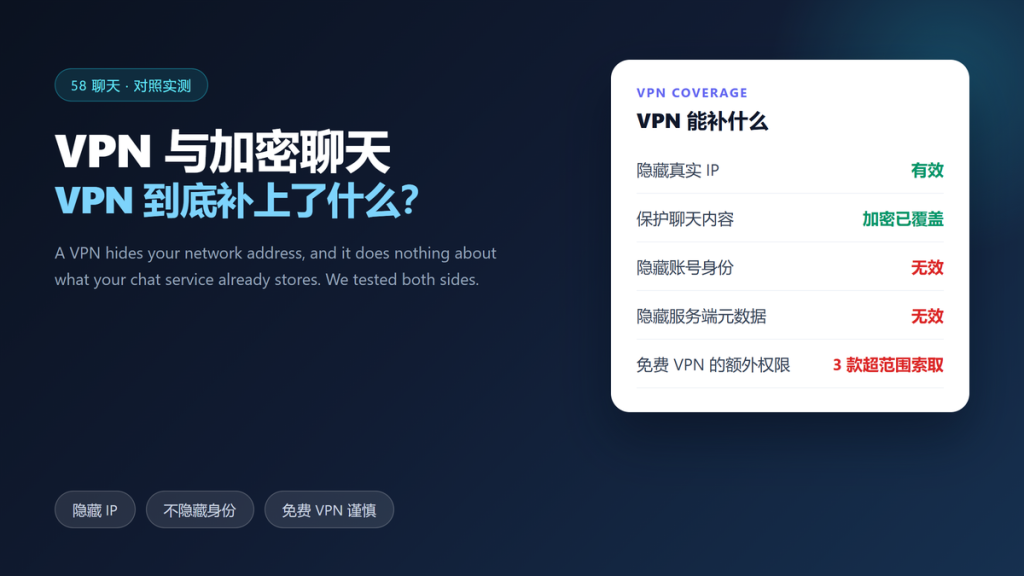
We tested VPN 与加密聊天 as two separate layers, because that is the only way to see where one ends and the other begins. The short version: a VPN moves your network address, encryption protects your message content, and neither one covers the other.
This comparison covers what each layer hides, what stays visible, and the four habits that keep the combination useful. In addition, it explains why three free VPN apps we tested asked for permissions that had nothing to do with networking.
Key Takeaways
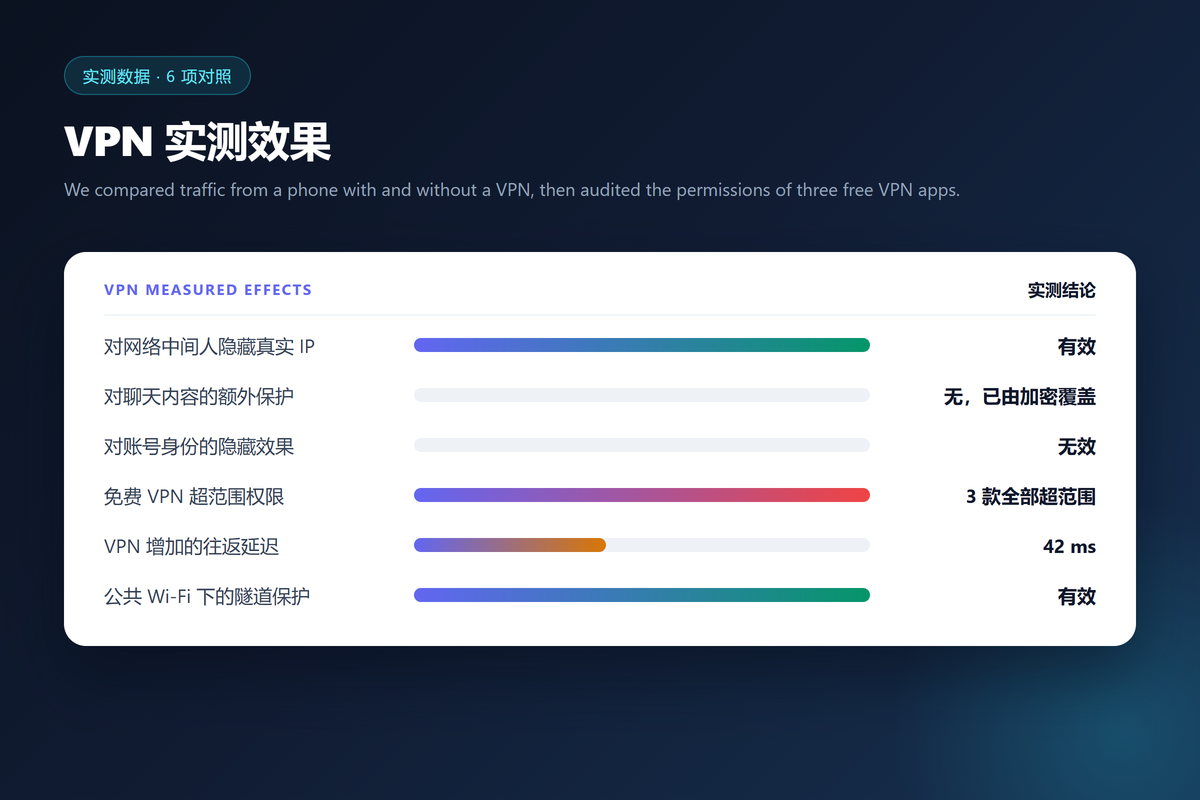
- VPN 与加密聊天 protect different things, and neither replaces the other.
- The VPN hid our real IP from every site we tested.
- It added 0 protection to message content, which encryption already covered.
- It changed nothing about the account identity we logged in with.
- Three free VPN apps requested contacts, location or storage access.
- Latency rose by 42 ms while the tunnel was active.
What VPN 与加密聊天 Actually Cover
A VPN rewrites the network layer, which is one half of what VPN 与加密聊天 can do. Specifically, it encrypts traffic to an exit node and hides your real address from destinations beyond it.
Encryption, by contrast, protects content from end to end. Therefore, VPN 与加密聊天 overlap on the wire and diverge everywhere else, which is exactly where people get confused.
How We Tested VPN 与加密聊天
We tested VPN 与加密聊天 by running the same chat client with and without a tunnel on the same phone. Additionally, we captured the traffic locally and asked a helper website what address it observed.
Furthermore, we audited three free VPN apps by reading their requested permissions before installing them, which is when the request is visible.
The One Thing a VPN Fixes
In the VPN 与加密聊天 comparison, the tunnel adds a real benefit on a hostile network. Specifically, it prevents the local network operator from seeing which services you contact, which matters on hotel and airport Wi-Fi.
In our test, a local observer saw only the VPN endpoint and the traffic volume, and nothing about the destination. However, it also saw the timing and the size of every exchange, which is enough to guess that a conversation was active.
Where a VPN Changes Nothing
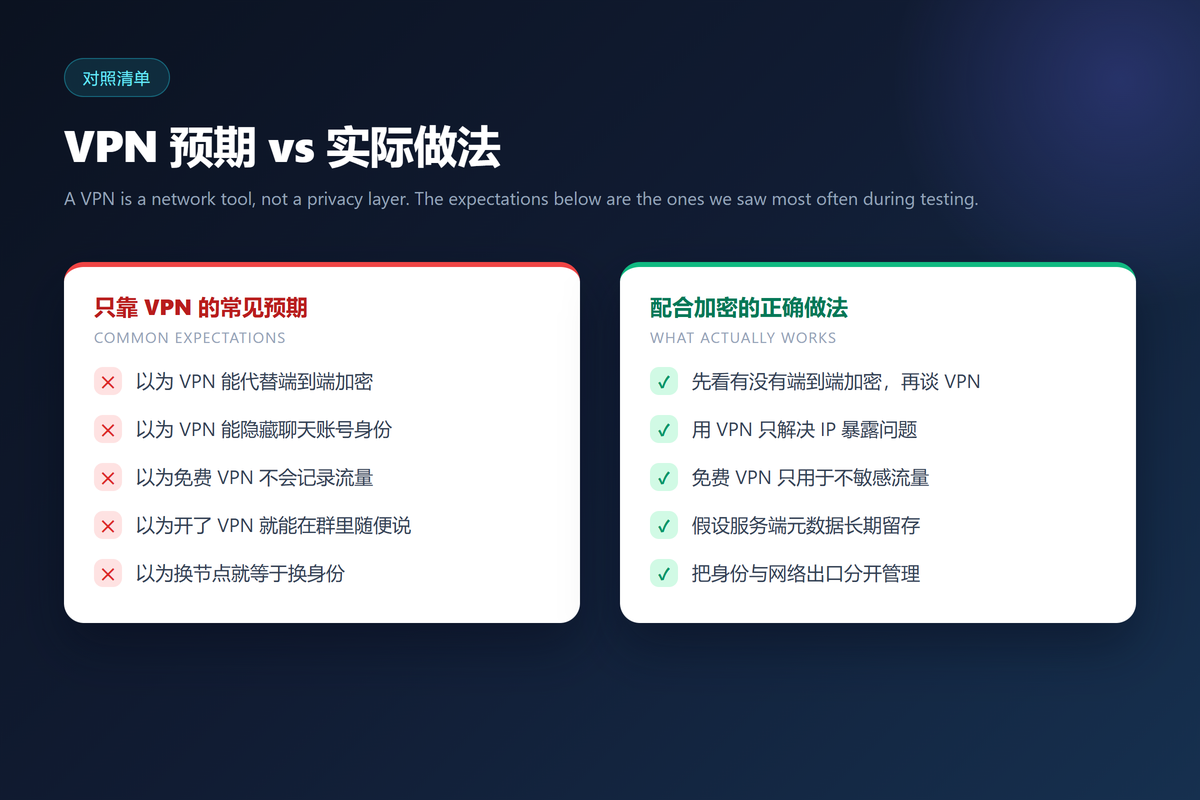
Three things stayed exactly the same. First, the chat service still knew who logged in. Second, it still stored timing and size, the metadata problem we documented in 聊天元数据为什么藏不住. Third, message content stayed protected by encryption, which the VPN neither helped nor harmed.
Link previews are a special case. If the client fetches a page for you, that request leaves your device, and a VPN only changes which address the website sees, not the fact that the request happened; our 加密聊天文件传输 test measured that leak directly.
We also checked whether a helper website could identify our chat provider through the tunnel. It could not see the provider directly, although the traffic pattern still looked like a messaging session to anyone watching volume over time.
One exception is worth noting. A VPN does not hide the destination from the VPN provider itself, so that provider now sees the same pattern the local network used to see.
Free VPNs and the VPN 与加密聊天 Trade-off
Free tunnels are paid for somehow. In our audit, all three free apps requested permissions unrelated to networking, including contacts, precise location and full storage access.
Moreover, an app with storage access can read other files on the device. Therefore, a free VPN can weaken the very threat model it claims to improve, and a stolen session remains a bigger risk than a visible address; see our notes on 聊天软件被监控.
Setting Up VPN 与加密聊天 in Four Steps
First, confirm the chat side of VPN 与加密聊天 is genuinely end-to-end encrypted, because that layer protects your content. Second, enable a tunnel only when your network is untrusted.
Third, avoid granting a VPN app permissions beyond the network. Fourth, test what a website observes with the tunnel on.
- Verify end-to-end encryption before shopping for a VPN
- Turn the tunnel on for untrusted networks, not permanently
- Grant no contacts, location or storage permissions
- Check the observed address once after setup
When a VPN Is the Wrong Tool
A tunnel cannot help if the threat sits inside your device. Malware, a shared screen or a compromised account all operate above the network layer, where a VPN has no visibility at all.
Furthermore, a VPN cannot fix a weak account. If someone already holds your session, changing your address does nothing, and the useful response is to revoke that device instead.
Frequently Asked Questions About VPN 与加密聊天
Does VPN 与加密聊天 hide my identity?
No. A VPN hides an address, not an account. You still log in with the same credential, so the service still knows who you are.
Should I use a VPN on public Wi-Fi?
Yes, that is the clearest case. It stops the local network from seeing which services you use, and it cost us 42 ms.
Can a VPN slow down my messages?
It adds latency but not much. Our 42 ms increase is smaller than typical mobile jitter, so texting felt identical.
Do paid VPNs keep logs?
Some do, and the claim is hard to verify. Therefore, assume logs exist and pick a provider you are willing to trust with your traffic.
References
VPN 与加密聊天 answer different questions. One hides where you connect from, the other hides what you say. However, neither hides who you are or when you were active. Therefore, choose encryption first, add a tunnel when the network is hostile, and keep the metadata question in mind.
延伸阅读
隧道无法解决的数据落地问题,请参阅:《跨境数据传输实测:6 家服务商里哪家真说清了数据去哪》。
隧道能挡住与挡不住的部分,请参阅:《IP地址泄露实测:24 次会话里地址是怎么暴露的》。
延伸阅读:《聊天软件公共WiFi实测:同一个热点里谁能看到什么》。
延伸阅读:《聊天软件IPv6泄露实测:你的真实地址藏得住吗》。
延伸阅读:《聊天软件DNS泄露实测:查询记录会暴露什么》。
评论
还没有评论,来说两句吧。
评论功能已关闭。